Wednesday, October 13, 2010

Mooncake madness

Not once did I ever think that I would make mooncakes. It’s not something that a layperson does or thinks that he or she can make. For one, they’re fiddly as hell to make. And the mid-autumn season is so short, it’s way easier to just go down to the shops to buy them. After about two decades of not eating them, here I am, suddenly obsessed by these sweet morsels from my childhood. As a child eating lotus paste mooncakes were already indulgent, if we were lucky, we’d get a double salty egg yolk bunger – now that was luxury in my time.

Having just returned from Singapore and Malaysia where the mooncake is seeing a modern revival, I was blown away by the breadth of variety of these suckers. I was hooked. The mooncakes in Asia are like pieces of mini art works – the pastry skin takes on the intricate carvings of flowers and Chinese calligraphy and the fillings infinite and cleverly combined with western ingredients. I also had to justify my recent horde of mooncake moulds – what good are they sitting in the cupboard?

I happened to buy a Malaysian food magazine, Flavours at the airport on the way back to Australia. My mooncake obsession could take hold – there was a spread on mooncakes and recipes. What luck! So today, I made my first batch of mooncake dough. I didn’t want to make both dough and filling – thought I’d take baby steps first. I’m not the best of bakers – most of my baking expeditions veer off in unexpected tangents! I used a peanut-shaped mould, a traditional calligraphy mould and a tablet shaped mould.

The peach-shaped calligraphy mould was by far the most diffcult mould to use. The dough stuck furiously to its sides and it took a bit of beating mould on bench to unmould the sticky stuff.

(golden syrup, lye water and oil mix resting)


I have used the dough on its own as biscuits although its purpose is to form a skin around fillings. The dough works quite well on its own though a bit sweet. I divided my dough and mixed half of it with a mixture of grated nutmeg and ground cinnamon for a slightly spicy flavour.


(this is the shiniest dough mix ever!)


(pre-oven specimens)

My version puffed up about double and as a result, lost most of its intricate patterns. Perhaps I put too much sodium bicarbonate in? Or maybe with a filling the dough keeps its shape better. I will make some lotus paste for the next batch and see what happens. The texture is pretty good, it's slightly chewy and spicy from nutmeg and cinnamon - not unlike a German Christmas cookie!


(post-oven specimens)

Here is Flavours basic mooncake dough recipe.

250ml golden syrup
110ml peanut oil (I substituted this with canola oil)
1tsp alkaline (lye) water
430g plain flour sifted
¼tsp sodium bicarbonate

1 egg lightly beaten for egg wash

Mix golden syrup, oil and lye water in a bowl until well combined. Cover with cling film and set aside for 1 hour.

Sift in flour and sodium bicarbonate . Mix to firm a dough – if the dough is too sticky, work in 1 to 2 tbsp flour. When the dough looks shiny and smooth, cover with cling film and rest for another hour before filling and shaping.

Baking: Preheat oven to 170°C. Place shaped mooncake biscuits on greased or greaseproof lined tray. Bake for 10 minutes. Remove and brush with egg wash. Lower heat to 160°C and bake another 10 minutes. Remove from oven when biscuits are golden brown.

Sunday, October 10, 2010

Singapore Singapore!

The quest for great food is always a good excuse to leave the country in exchange for new culinary experiences. A wedding is an even better excuse to leave the country. My cousin YW finally tied the knot having found his soulmate in Singapore. Many family members traveled from Malaysia and with family and friends coming from various overseas countries. The wedding was beautiful. The bride and groom looked tired but very happy. I’ve got the menu from the wedding reception to reflect what is typically on offer if you do decide on a Chinese-style reception in a big hotel.


(menu from Chinese wedding)

The streets of Singapore seem almost swept clean of debris and most eating places on the surface look sanitised and very clean. Street food in Singapore has been kept confined in ‘coffeeshops’ in specially-built buildings for this purpose. There are no longer sit-on-footpath type eating. As a result of the government’s zeal for cleanliness, Singaporean food stalls shoved into custom-built buildings have lost a part of their street appeal – the vibrancy and authenticity just isn’t there. Food isn’t overly expensive but neither is it overly cheap. A typical bowl of noodles will cost around $5. Don’t get me wrong, there is good food to be had in Singapore, just don’t expect raw, edgy street food, like you would in the rest of South-east Asia.

A good place for a cheap eats is Singapore Zam Zam Restaurant, recommended by fellow Brisbane blogger, Tunaf_ranch was a hit. The murtabaks here are pretty big and crispy perfect with a pint of frothy teh tarik.


(fat crispy parcels of goodness at Zam Zam)

A good friend of mine and Singapore resident, D brought us to a Teo Chew restaurant, Hung Kang for dinner. It was a joy to find beautifully prepared food at very reasonable prices. We started with pomegranate-shaped bags with crispy spring roll skin filled with diced chicken, crunchy chestnuts and spring onions. A thick, sweet soy sauce made a good dipping accompaniment. Stir fried kai lan (Chinese broccoli) with shiitake mushrooms and crispy fish skin was a textural sensation. The match of crunchy vegetables with silky mushrooms and crispy skin is so clever. The century egg stir fried with water chestnuts and black fungus was a highlight. The century egg loses a bit of its pungency but marries perfectly with the other ingredients. Deep fried goose was tender and very moist.


(dinner at Hung Kang)


The pork thigh braised in a complex soy broth with chestnuts was excellent eating – the meat perfectly fall apart tender with nutty chestnuts and a layer of gelatinous rendered fat.


(this braised pork dish was absolutely delicious!)


(Hashima (or frogs glands)with gingko nuts)

We finished off with snow frog glands with gingko nuts warmed in a sweet soup and oh nee (yam in lard and sugar) and cheng teng (cold clear dessert soup with longans, snow fungus, dried jujubes). It was an interesting array of textures, flavours and ingredients and acted as a good palate cleanser.

We were also lucky to visit while the mooncake festival was on. There were mooncakes everywhere we looked. Some of the streets downtown turned into mooncake alleys. Dozens of Chinese bakeries and specialist mooncake makers displayed their colourful wares in tents. Singapore has not only modernised its street food, the traditional mooncake of my childhood has also been transformed into elaborate pieces of artworks.


(this photo doesn't do the mooncake booths justice but imagine these stalls multiplied by about thirty)

Hundreds of mooncakes were on show – the traditional pastry with lotus paste with egg yolks were a minority. The east-meets west samples seemed to rule. Five star hotels have also gotten in on the action – hotels like Raffles, Shangri-La, Goodwood Park Hotel were showcasing exquisite-looking specimens.


(and these little mooncake piglets went to market...)

We said goodbye to the old-style baked pastry with lotus seed varieties and said hello to a new variety of dewy delicate snowskin mooncakes. These snowskins come in D24 durian paste, apple caramel, mango and pomelo, single malt whiskey, chocolate with rum and raisin and the piece de resistance – champagne and truffle. These exotic specimens don’t come cheap – expect to pay from $42 for four pieces. We moved around these mooncake booths trying their free samples.


(sample of local bakery, Bakerzin's snowskin mooncakes from their 2010 collection!)

I managed to find some traditional wooden mooncake moulds in Malaysia and am going to start to try and make some mooncakes. It’s all a bit sad but wooden moulds are becoming harder and harder to source – plastic is gaining momentum with cooks everywhere apparently. I am going to attempt making some mooncakes in the next couple of weeks time so stay tuned.


(mooncake moulds washed and seasoned with oil)


D also brought us to sample beef balls noodle soups at Purvis Street. It was a memorable lunch at a beef ball koay teow restaurant in Purvis Street in Singapore.

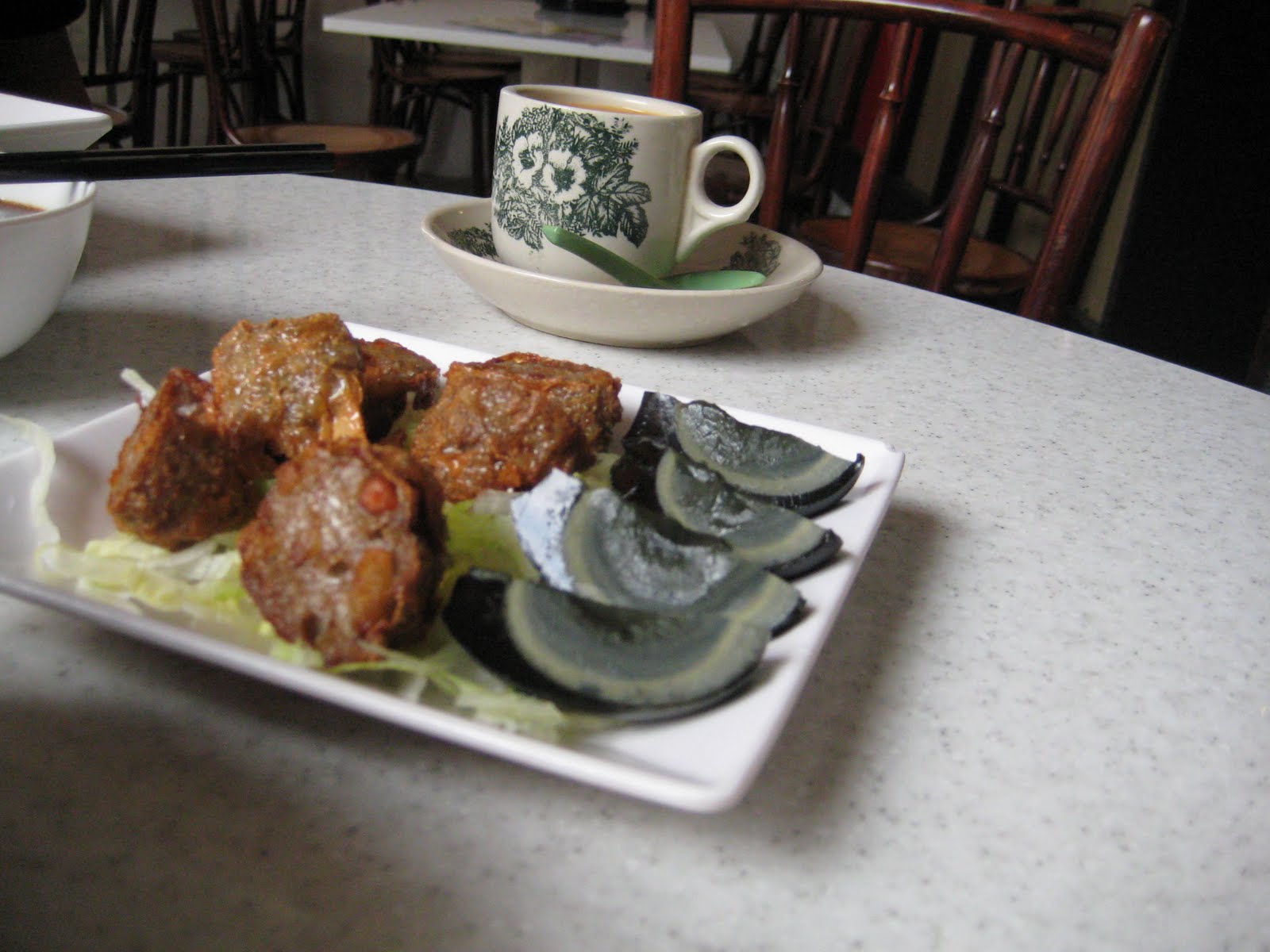
The appetisers of lor bak (spiced fragrant meat with a crispy bean curd skin) and century egg were a good combination.


(lor bak with century egg appetisers)


(beef ball noodle soup. Photo by Neil Lee)
The broth was complex and rich without being overpowering and the beef balls were very tasty. The chilli sauce with Calamansi limes gave the beef some kick too.

The Teo Chew dinner, murtabak at Zam Zam and beef ball noodles lunch were some of my more memorable eats in Singapore.

The mid autumn mooncake festival ran from 10 August to 22 September 2010.
Singapore Zam Zam Restaurant can be found at 697, 699 North Bridge Road, Singapore.
Hung Kang Teochew Restaurant can be found at 28 North Canal Road, Singapore.
7th Storey Hainan Cafe, 27 Purvis Street, Singapore.
Monday, September 6, 2010

Real Food Companion by Matthew Evans


The Real Food Companion by Matthew Evans

I had the pleasure of meeting Matthew Evans at his book launch earlier this year. His talk was informative and passionate. His attitude towards food and his frankness about not having a lot of agricultural knowledge to begin with provided me with motivation for learning more. Matthew Evan’s event was sponsored by Food Connect (a great organisation committed to farming sustainability and communities). I had much respect for Evans when he was a Sydney Morning Herald food reviewer and I have even more respect for him now that he’s championing the awareness of sustainable farming and opting for simpler eating and living. For those of you not so familiar with his written work, you may be more familiar with his television show, the SBS food documentary Gourmet Farmer.

I’m a big fan of Murdoch food books in general, but this tome is really a little bit special. Not only is the book beautifully made, from the rustic jacket to the photographs and text – a lot of care and love has gone into it. Evan’s prologue is especially touching. The publication of the book coincides with the birth of his first child. The prologue turns into a kind of ‘life’ letter, which I guess, is also a form of love letter to his first born. With this, Evans introduces his family and his food aspirations to his child. He sagely advises his child to “Dine in front of the television at your own peril. Keep your self-esteem intact and your front door open to visitors. Keep the pantry full and the larder enriched. Keep the invitations going to those who seek refuge, as well as those who come to bring joy. Be generous with the ladle and cavalier with the wine. Cook, my child, for hospitality is the glue that binds humanity together.” What lovely sentiments.

(the book with its scarecrow jacket on)

Evans’s life-changing journey starts with tasting real milk, which for him, is a driver for uncovering the real, core flavours of ingredients. He is not a fan of mediocrity, he supports ethical eating and like the title of the book suggests, he is interested in real food. Evans could’ve bleated on and on about sustainable eating, farming and the feelgood factor of buying and eating organic. Yes, he espouses all of these food philosophies but he doesn’t come across as greenly pious or shouts obnoxiously from his soapbox. He makes the reader aware of these issues gently; almost reminds us that we shouldn’t neglect the soil that nourishes our vegetables and the welfare of the animals that we depend on for food.

The chapters are well laid out and categories of ingredients are explained in simple, easy-to-understand language. The beauty of the Real Food Companion is that it is a personal collection of rustic, delicious recipes combined with introductions to individual farmers and their produce, and explanations of uses for ingredients. The dairy chapter sees recipes like baked nutmeg custard, goats’ milk latte cotto and labna. The flour chapter shows off the flexibility of wheat, whether for turning leftover crusts into a bread and butter pudding or dough being kneaded into silky pappardelle. The recipes are never overcomplicated or fussy. Traditionalists will delight in the English and French comfort foods like homemade bacon baked beans and coq au vin; and the multiculturalists will appreciate the taxi driver’s lamb curry and fattoush.

(Matthew Evans's homemade bacon baked beans)

And where would a good reference/cookbook be without a workable index? The index is broken up into two separate categories: Food and Topics. The food index is user-friendly and pretty thorough although some food entries could have been more practically thought through. For a book that is part reference and part cookbook, the level of indexing is spot on. The Topics section is easy to use but some entries seem to have been overlooked and locators are not all there. Overall, Real Food Companion is a heartwarming read and provides inspiration to all of us who are vying for a change of pace in our hectic lifestyles. This book makes me want to find time to nourish and grow something wonderful from a little patch of dirt.

Wednesday, March 31, 2010

Breakfast at The Wolseley book review


Love him or hate him, A.A. Gill certainly has a way with words. The wordsmith puts his intrepid travels and eating adventures aside and goes back to the United Kingdom, in search of breakfast. His book, Breakfast at The Wolseley is based solely, entirely on the promise of breakfast, actually, the entire book is focused on the famous English institution, The Wolseley in Picadilly, London. This art deco period building was commissioned as a showroom for Wolseley Cars in the 1920s and 30s. This opulent and grand building was used by Barclays bank until the late 1990s. Two men, Chris Corbin and Jeremy King acquired the building in 2003 and commissioned architects to restore the building to its former glory and set about turning it into an European-inspired café/restaurant. A.A. Gill goes behind the scenes at The Wolseley to experience firsthand the machinations behind what it takes to provide first-class breakfasts. This sumptuous book of beautiful photographs of building and its food is something for the coffee table. It’s the perfect time-filler for a rainy Sunday afternoon. A.A. Gill fans will love this. And for those who can’t stomach Gill’s self-indulgent reviews – this one might just be the one to ease you back into the Gill fold. Gill is restraint in this narrative and has kept his sarcastic wit to a minimum in this publication. His take on eating breakfast is poignant and at times I think requires some reflection.

Breakfast is everything. The beginning, the first thing. It is the mouthful that is the commitment to a new day, a continuing life. …Breakfast – simple, elaborate, hurried, deliberate or skipped – is an unconsidered moment of global communion. Somewhere, someone is starting breakfast and thinking, “Today will be better than yesterday.”

I like the fact he’s written about breakfast in a completely different light – it’s something that I haven’t taken into much consideration, Gill’s right: it’s something we all kind of take for granted. My breakfasts become more elaborate on weekends, I do like to eat adventurously when I’m traveling. I have no qualms about having cake and coffee or roti and curry for breakfast but I find myself eating almost the exact same breakfast on weekdays.

Breakfast is a meal apart. It isn’t like the other organized consumptions of food in which we all part. Even though it’s a fixed moment, breakfast is pre-form – a conceptual meal. It doesn’t have courses or an order; it isn’t prescriptively sweet or savoury; there is no generally accepted sense of its length or constituent parts. It’s bespoke, tailor-made to you: a private meal or habit. Breakfast is the most personal and idiosyncratic construction. It is the only meal most of us feel wholly comfortable eating on our own…

See that wasn’t so bad. None of this smug, self-serving talk – what a relief! The book is split into seven parts. History of the building and place, a short history of breakfast, the concept of the Viennoiserie complete with recipes. Gill’s even provided an eggs section, an English breakfast section,fruit and cereals and Tea, Coffee and Hot Chocolate section - all with recipes and short blurbs. Viennoiserie is the French collective term for pastries from Vienna. And what a collection of butter-enriched pastries there are in the book.


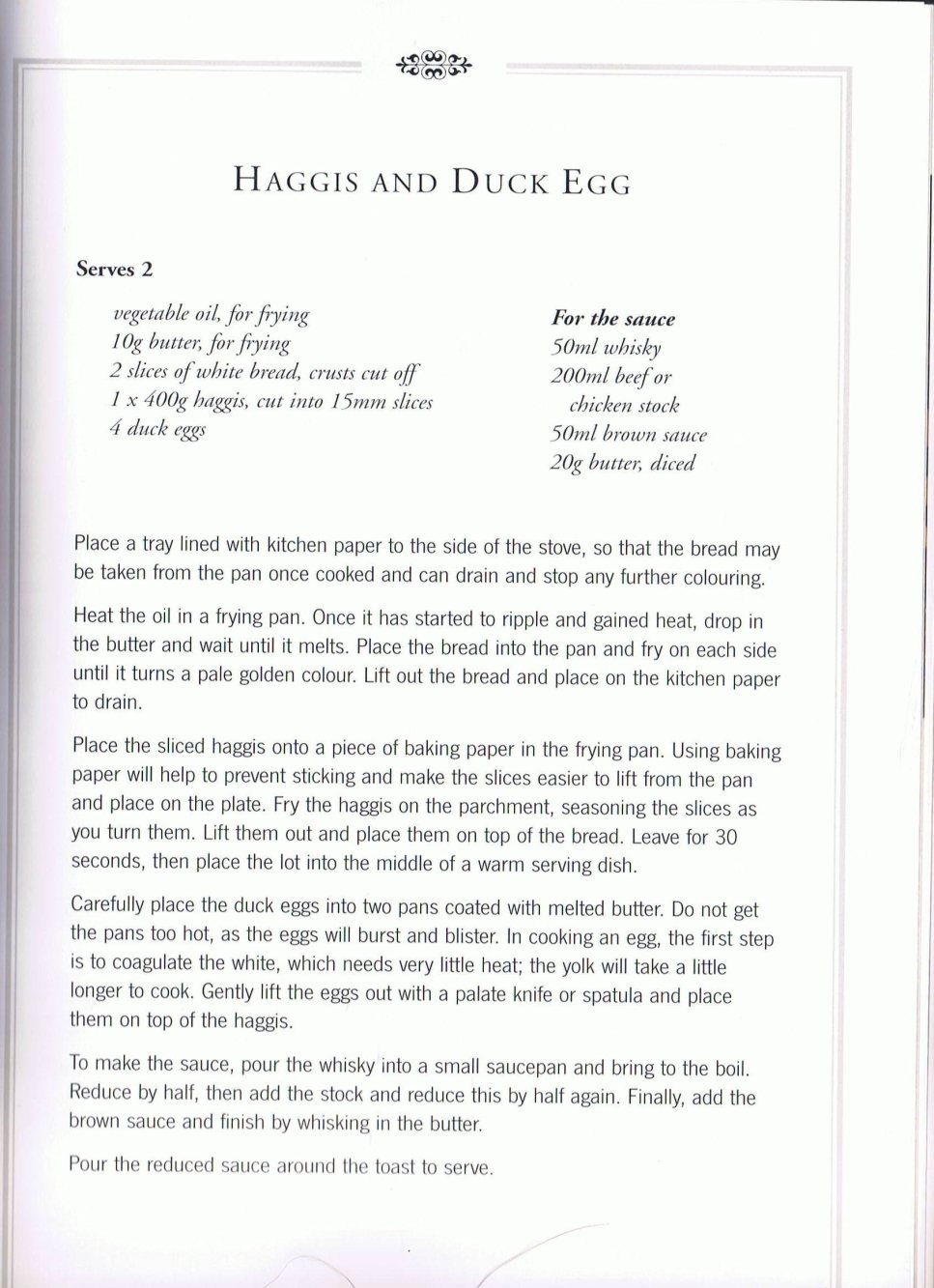
A recipe for haggis and duck eggs from the book

Gill’s managed to evoke the goings-on behind the scenes at The Wolseley with great verve and sensitivity. All the ‘invisible’ people that make breakfast possible get a look-in. Almost all nationalities under the sun can be found in the kitchen of this one place, all making European pastries and English breakfasts. We’re introduced to the tourier. I had not heard of, or knew what a tourier was until I read the book.

A tourier is a risen-pastry maker. ‘He’s not strictly a baker, or a patissier, or a confectioner; he is a tourier. …the tourier leans over his dough, folding and shaping with practised economy. Watching craftsmen craft is one of the quietest and deepest pleasures of a cack-handled life. The tourier arranges the pastry-pale, embryonic croissants on a slick baking tray and slides them into a rainforest-hot oven.

I enjoyed leafing through and reading this book, I didn’t think I’d enjoy reading about A.A. Gill’s take on the intricacies of making and serving breakfast as much I did. This book is for anyone interested in food and the social intercourse that surrounds breakfast. It’s also for those who enjoy the thing that is a perfect, crisp, flaky croissant.


Fresh croissants from the oven at The Wolseley

Monday, February 22, 2010

Bangers and Mash scream for ice cream

I must say I signed up for this trial of Yoghurt Plus thinking it was literally yoghurt for dogs. I usually give my dogs Bangers and Mash a tablespoon or two of natural yoghurt several times a week. They love it. They lap up the cold stuff like we would ice cream, I imagine! I wasn’t quite so sure it was good for them though so I was very excited when I saw the Yoghurt Plus. I must say I was mistaken about Yoghurt Plus being yoghurt – it turned out to be dog kibble with lactose-free yoghurt added. Never mind my disappointment - Bangers and Mash seemed very excited when the delivery man dropped these off. Interestingly the product was developed by ex AFL player and sports personality John Crosbie Goold. He thought if probiotic bacteria is good for human digestion and general wellbeing, perhaps the same health benefits also could be harnessed in animals. After years of trials on animals in both commercial and domestic environments, Yoghurt Plus was born. The makers of this product believe that feeding our pets with this particular product helps with many health issues.

The said benefits that I am interested in trialling on Bangers and Mash are:

Reduction in stool volume and odour (poor Mash I am convinced has irritable bowel syndrome)
Healthy shiny coats
Reduction in lawn burn (this would be particularly helpful too)
increased immmunity

It will be interesting to see if there are any changes in my dogs in the next several months.

Bangers and Mash take stock


Bangers is a border collie/blue heeler/kelpie we think. He’s a rescue dog from the RSPCA.

Mash is a border collie/spaniel(?), also a rescue dog from the RSPCA.


Day One of Yoghurt Plus
Bangers: Gave usual amount of food. Several hours later Bangers threw up a huge pile of the stuff. I’m not sure if he had a reaction to the new food. Thankfully I didn’t take a photo of his spew, it was rather, how shall we say, unappetising.

Mash: Nothing came up – fine as normal.

Day Two
Bangers: Decreased the amount of food today. Seemed okay no evidence of chuckups in the garden.

Mash: Same amout of food as Bangers. Love it. Want some more mum. Mash has terrible morning breath that seems to last all day. Let's see if this stuff clears up her poodle breath.

Day Three
Bangers & Mash: Nope, all seems okay though amount is less than what I’d give them. I notice that the fat content is 12% and 26% protein - their usual food is 10% fat and usually 20% protein.

Both kids hang around in the kitchen a lot more than usual, waiting for scraps methinks.

Friday, February 19, 2010

Ducasse and his cookbook


Alain Ducasse
Spoon Food and Wine review

I am a big fan of books in general but have a very soft spot for food books and cook books. A post on Twitter recently by Barbara from winos and foodies on the unusability of some celebrity chef’s (he who shall be nameless!) recipes got me looking at cookbooks with a more critical eye. Sure, we’ve come across recipes that look good on paper but fail miserably even when you follow it to the tee. I think most of us have had that experience. Some recipes are perhaps inadequately tested in the kitchen, editors may have missed a typo in the amount of ingredients needed. A whole gamut of things can go wrong when dealing with recipes and cookbooks.

I was excited when I found a book with Alain Ducasse’s recipes at the library. What was I expecting to see in a cookbook by the famous and very prolific French chef? Did I expect to see elements of haute cuisine reflected in the construction of text and photographs? Did I expect elegance and refinement reflected in the recipes? Monsieur Ducasse has many, many restaurants under his belt: his bars, restaurants and bistros litter the cities and countrysides of France, Monaco, Tokyo, America, Lebanon, Italy, England and Mauritius. Ducasse has a very impressive line up of eateries and yes, even more impressive that some of these restaurants have multiple Michelin stars. So what did I think of this cookbook?

The Spoon Food and Wine cookbook covers recipes from Ducasse’s Spoon franchise. In his introduction, he states that the book was conceived in the ‘spirit of exploration, analysis and iconoclasm.’ He continues, “Anyway, that is how this book was designed. You will see that there are no one-way streets, that you are not trapped on a ‘motorway’ of taste. It’s a case of ‘as you like it’. If you want to take a side turning, reverse, start again, no one will stop you. But, when it comes to stopping short – no way! …in this sense, the cooking of Spoon is instinctive: chew, munch, eat, drink. These ‘deconstructed’ dishes have all the adapatability of basic cooking. What I like about the ethos of Spoon is that it combines the simplest, most fundamental gesture – dipping a spoon into an earthenware bowl – with modern sophistication.’

I laughed at the motor highway metaphor for cooking styles and then I became confused over the description of the spoon being dipped into an earthenware bowl with utter modern sophisticated abandon. Wait a minute, my detection of pretension/wanker siren is going off! I know celebrities have great authority and say in a lot of things but when does an editor not edit or refine a clumsy introduction? It gets worse from here. The recipes seem relatively easy enough and aren’t overly too complicated but the problem with this book lies in its design elements. Surely you can have a well-designed book (think Murdoch Books’ plethora of beautiful and practical cookbooks) with good-looking visuals without the book looking like the contents of a dog’s breakfast.

The designer somehow has managed to turn a cookbook into a pseudo-people/fashion shoot and managed to talk the editor into agreeing to use the photos. Shots of attractive young things lounging in restaurants are interspersed throughout the book. Don’t get me wrong, the photographs in the book are beautifully and artistically shot.


What I would like to know is whether people find over-the-top design/photographic elements in a cookbook detract from the recipes and cooking techniques. I found my eyes roving across the pages, struggling to look for some semblance of ease of readability. Typographic inconsistencies rule on the page – recipe ingredients are condensed and line spacing reduced. The font used for the cooking instructions, on the other hand, is enlarged but printed ultra light with cooking steps in an extra bold red font. These red ‘steps’ punctuate the page too boldly and I found them very distracting because the actual instructions were so light therefore hard to read. Some of the choices of very busy background photographs render the ultra light font almost invisible.


By now you’re probably thinking ‘what a bloody nitpicker’ but I am after all, a professional book indexer and I tend to look at things in great detail. If you’re thinking that I can’t pick this book apart anymore, I haven’t even started on the index! Two thirds of the pages dedicated to the index are supplemented by very large photographs of Ducasse’s compotes and salsas in tumblers. What use is an index if you can’t use it or refer to it? (FYI, this link to a badly indexed book is quite hilarious)

If you think you want to look up chicken dishes – you’d look under C for chicken or P for poultry. Well, chicken is not under ‘chicken’ or ‘poultry’ surprise, surprise. It’s under ‘seared chicken fillets’. Seafood is nowhere to be found, instead you’ll find it also under ‘seared red mullet, etc’ Desserts? Ice creams? Try ‘The big meringue’.

Tomatoes? Forget it if you think it’s under ‘vegetables’ or ‘tomatoes’ – it’s under ‘stuffed tomatoes and potato straws’. I could go on and on but I won’t bore you. If there was ever a nomination for a bad index: this is it. This thoroughly inadequate index, is after all, a fitting end to a very superficial fashionable book about the way food should look and the kinds of people who aspire to eat at the Spoon establishment. There is no warmth or generosity depicted in any of the pictures – the images of food is gorgeous (yes) but clinical and exacting, devoid of any emotion or spontaneity. This book leaves me stone cold and I am glad I didn’t invest money indulging in something so inaccessible and unapproachable.

Tuesday, February 9, 2010

A hop, skip and a jump to Grasshopper Kitchen

Grasshopper Kitchen is injecting much life into the retail strip on Vernon Terrace. The interior space utilises the building’s history as a wool store with its part distressed walls, made it part quirky with hessian bag lamp coverings and thrown in a bit of chic with a sleek fitout. This fusion of many design elements extend into the East-meets-West menu.

Grasshopper was the venue for the second Brisbane’s food bloggers’ dinner organised by Gastronomy Gal and Melanger Baking, and what an enjoyable night it was. Todd Rumble, proprietor of the wine bar, Claret House played host and gave an informative and entertaining wine commentary on the night. Six interesting wines were matched with six courses. Australian wines from the Tamar Valley, Margaret River and Orange were featured, Argentinian and French made the rest of the tasting. The six courses were a tasting menu for their autumn set so we all got a taste preview.


Japanese scallop with duck ma hor, prosciutto with daikon and wasabi puree

Dishes were presented delicately and beautifully – highlights being the slow braised beef cheek in a Vietnamese-style stock with a chilli polenta cake and baby vegetables. The cheek was rich and gelatinous, its flesh melting away from our forks. The scallops presented with sliver of prosciutto and a version of a Thai-style duck ma hor (or also known as galloping horse) was another highlight. The scallop was plump and sweet contrasting nicely with the salty prosciutto; the minced duck with peanuts was spicy and sweet at the same time with I think, minced pineapple on top. The daikon and wasabi puree tasted deceptively like cauliflower – it was very good with a bit of kick.


Beef cheek slow braised for six hours in Vietnamese-style aromatic stock with coriander chilli polenta cake and baby turnip & carrot

Having had a degustation menu here, it will be interesting to see what their normal a la carte menu is like. We didn’t just indulgently enjoy ourselves, the proceeds of our dinner went to Sydney’s Red Lantern restaurateur, Luke Nguyen and Suzanna Boyd’s Little Lantern Foundation, a non profit project for disadvantaged and underprivileged Vietnamese. Grasshopper’s talented head chef Minh Le shares a very similar refugee story to Luke Nguyen, arriving in Australia in 1979. The people who call for an end to accepting boat people should remember that refugees and migrants who come to Australia deserve a chance. Imagine an Australia without Cheong Liew, Frank Camorra, Tetsuya Wakuda, Kylie Kwong, Luke Nguyen, Janni Kyritsis, or George Calombaris (heaven forbid!). What a poor culinary abyss we’d be without them.

Claret House, by the way, is conveniently located next door to Grasshopper if you decide you want to amble along and have a taste of some niche wines.